Patient Education Materials: Design That Improves Outcomes
Patient education materials are essential tools for improving health outcomes. When patients understand their condition, treatment, and self-care instructions, they comply better with treatment, experience better outcomes, and are more satisfied with their care. Yet many patient education materials are dense, jargon-filled, and hard to understand. Well-designed patient education materials bridge the gap between clinical expertise and patient comprehension. The Centers for Disease Control (cdc.gov) and the National Institutes of Health (nih.gov) provide health literacy standards that inform effective design.
Effective patient education materials serve multiple purposes: they improve patient understanding and compliance, reduce repetitive questions and phone calls, build trust in your practice, and serve as marketing tools that demonstrate your expertise. A practice that provides clear, helpful education materials stands out as patient-centered and authoritative. Our medical graphic design services create patient education materials.
Key principles of effective patient education material design include:
1. Plain Language: Write at a 6th to 8th grade reading level. The average patient reads at an 8th grade level, and health literacy is often lower. Avoid medical jargon, define necessary terms, and use short sentences. The Centers for Disease Control (cdc.gov) plain language guidelines provide standards. Plain language improves comprehension and compliance.
2. Visual Communication: Use illustrations, diagrams, and infographics to explain concepts. Visuals communicate far more effectively than text alone—patients retain more from images than from words. A diagram of a procedure, an illustration of an anatomical structure, or an infographic of recovery steps aids understanding. Our medical graphic design services create custom visuals.
3. Logical Structure: Organize content logically—start with what the patient needs to know first. Use clear headings, bullet points, and numbered steps. Break complex information into digestible sections. A logical structure helps patients find and remember information. Avoid dense paragraphs that overwhelm readers.
4. Action-Oriented Content: Focus on what patients need to do, not just what they need to know. Use action verbs and clear instructions. 'Take your medication with food' is clearer than 'medication should be taken with food.' Action-oriented content improves compliance. Number the steps patients need to take.
5. Culturally Appropriate: Consider the cultural and linguistic diversity of your patient population. Offer materials in multiple languages where appropriate. Use culturally relevant examples and imagery. The National Standards for Culturally and Linguistically Appropriate Services (thinkculturalhealth.hhs.gov) guide healthcare organizations on cultural competence.
6. Readable Typography: Use readable fonts—at least 12pt for print, larger for elderly patients. Sans-serif fonts are generally more readable. Ensure sufficient contrast between text and background. Avoid all-caps and decorative fonts. Readable typography ensures patients can actually read and use your materials.
7. Brand Consistency: Patient education materials should match your practice branding—logo, colors, typography. Consistent branding reinforces professionalism and makes your materials recognizable. Patients trust materials from their healthcare provider more than generic handouts. Our graphic design for medical practices services ensure brand consistency.
8. Multiple Formats: Provide education in multiple formats—print brochures, digital handouts, website content, videos, and infographics. Different patients prefer and learn from different formats. A video may work better for one patient; a brochure for another. Our medical explainer videos service creates video education content.
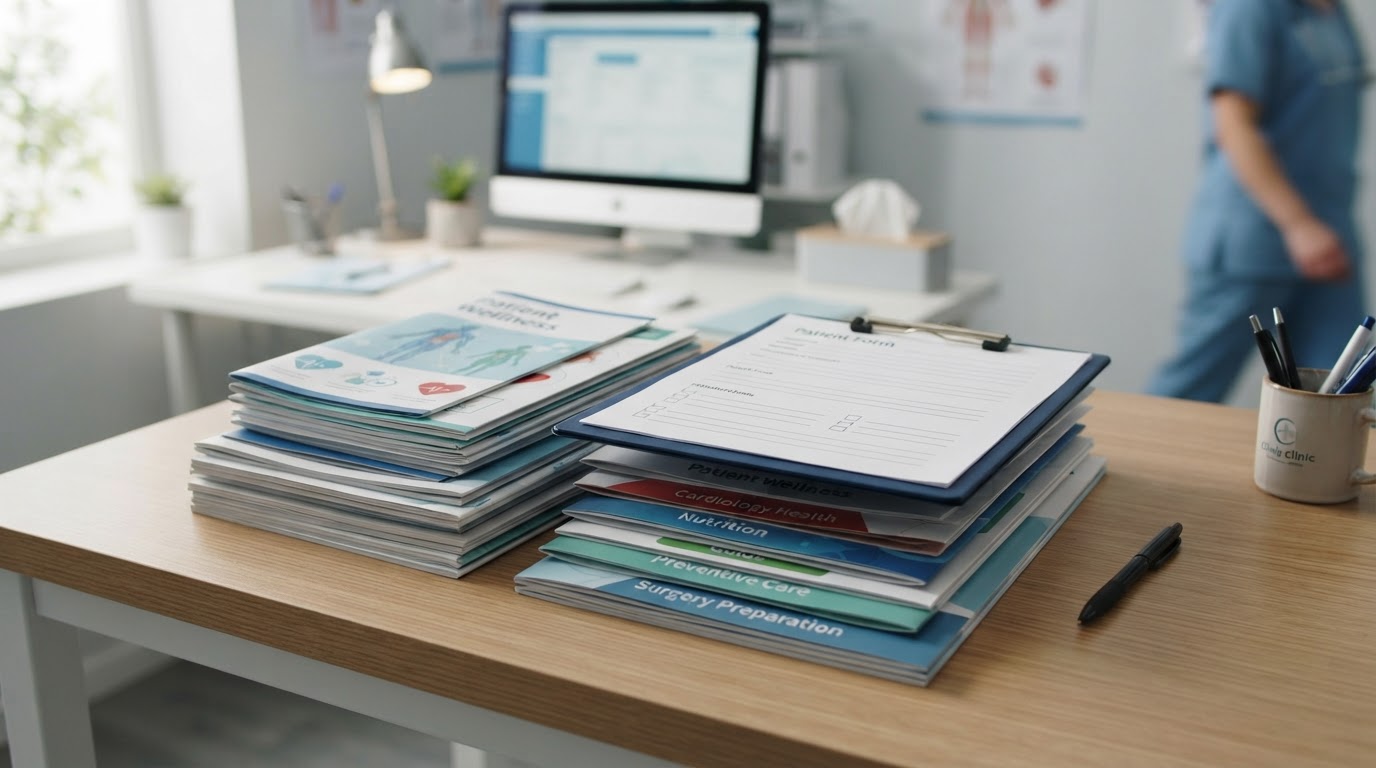
9. Procedure-Specific Materials: Create education materials specific to each procedure or condition you treat. Generic materials are less helpful than targeted content. A knee replacement patient needs different information than a dental implant patient. Procedure-specific materials improve relevance and compliance. See our medical brochure design services.
10. Pre- and Post-Procedure Education: Provide education before and after procedures. Pre-procedure education reduces anxiety and improves preparation. Post-procedure education supports recovery and compliance with aftercare instructions. Both improve outcomes and satisfaction. Our interactive medical forms service can integrate with education workflows.
11. Accessibility: Ensure materials are accessible to all patients, including those with visual impairments or limited English proficiency. Provide large-print versions, offer materials in multiple languages, and ensure digital materials meet WCAG 2.2 AA standards. The World Wide Web Consortium (w3.org/WAI) provides accessibility guidelines.
12. Test and Refine: Test materials with actual patients to ensure comprehension. Ask patients to explain what they understood. Revise based on feedback. Patient-tested materials are far more effective than those created without patient input. Continuous improvement based on patient feedback produces better education materials over time.
Well-designed patient education materials improve outcomes, compliance, and satisfaction while reducing repetitive questions and building trust. Practices that invest in clear, helpful education materials stand out as patient-centered and authoritative. Explore our medical graphic design and medical brochure design services, browse our portfolio, or request a free consultation to create patient education materials for your practice.
Frequently Asked Questions
Explore our services
Learn how we help medical practices grow with Medical Brochure Design.