Physical Therapy Brochure Design That Drives Referrals and Patient Commitment
A physical therapy brochure must motivate patients to commit to their recovery while giving referring physicians confidence in your clinic. Here's exactly what to include, the features that matter, and what makes a PT brochure effective at filling your schedule.
What Should a Physical Therapy Brochure Include?
The essential content sections every effective physical therapy brochure must include to educate patients and drive consultations.
Practice Identity & Branding
Lead with your clinic logo, name, and tagline in a clean, energetic brand system. Physical therapy is about movement and recovery, so a dynamic, active visual identity signals progress and optimism. Include your main phone number and website prominently so patients and referrers can reach you immediately.
Conditions & Specialties Treated
List the conditions you rehabilitate: post-surgical recovery (joint replacement, ACL, rotator cuff), sports injuries, back and neck pain, vestibular and balance disorders, work injuries, and neurological rehabilitation. Group them by category with simple icons so patients and referrers can quickly identify your expertise.
Treatment Approach & Techniques
Outline your therapeutic approach — manual therapy, therapeutic exercise, neuromuscular re-education, modalities, and specialty techniques like dry needling or blood flow restriction. Patients and referrers want to understand your methodology and why it produces better outcomes than a generic exercise handout.
What to Expect & Treatment Timeline
Describe the patient journey — initial evaluation, goal-setting, treatment sessions, home exercise program, and discharge planning. Include a typical timeline for common conditions so patients understand the commitment required and referrers know what to expect for their patients.
Therapist Bios & Credentials
Feature professional headshots and concise bios for each physical therapist, highlighting licensure, specialty certifications (OCS, SCS, NCS, WCS), advanced training, and years of experience. Referring physicians and patients both scrutinize credentials, so make specialty certifications prominent.
Outcomes & Patient Success
Include outcome statistics, patient testimonials, or success stories that demonstrate measurable results. Physical therapy is results-driven, so showing that patients return to sport, work, or daily activity builds confidence in your clinic's effectiveness.
Office Locations, Hours & Contact
Close with full clinic details: all locations with addresses, phone numbers, fax, appointment hours, accepted insurance plans, and a clear call to action to schedule an evaluation. Include your website and online scheduling link so patients can book directly.
Features to Include in Your Brochure
Design and functional features that elevate a physical therapy brochure from ordinary to exceptional.
Tri-Fold or Multi-Page Booklet Format
Choose a tri-fold (6-panel) layout for a concise clinic overview, or a multi-page booklet when covering many specialties and techniques. Match the format to your content volume and distribution — waiting room, referring-physician packets, or community sports events.
Condition Icon System
A consistent set of icons (post-surgical, sports, spine, balance, neuro) lets patients and referrers scan the brochure and find relevant expertise instantly. This visual navigation system improves comprehension and keeps the layout clean.
Active Lifestyle Photography
Use authentic photography of patients in motion — walking, lifting, returning to sport — rather than static clinical shots. Active imagery reinforces the outcome patients want and the energetic, optimistic tone physical therapy represents.
Premium Paper Stock & Finish
Patients and referrers associate print quality with care quality. Use heavyweight matte or soft-touch stock with spot UV on key elements. The tactile experience of a premium brochure reinforces the perception of a premium clinic.
Referrer-Friendly Layout
Design a panel or section specifically for referring physicians — your specialties, referral process, fax number, and what their patients can expect. A referrer-focused section strengthens physician relationships and drives consistent referrals.
QR Codes to Online Scheduling
Place trackable QR codes linking directly to your online scheduling or appointment request form. This bridges print to digital and lets you measure which brochure distribution channels drive the most evaluations.
What Makes an Effective Physical Therapy Brochure?
Strategic principles that turn a well-designed brochure into a patient-acquisition tool.
Motivating, Plain Language
An effective PT brochure replaces clinical jargon with motivating, plain language. Instead of 'neuromuscular re-education,' write 'retraining your body to move correctly after injury.' Patients who understand their recovery are more likely to commit to the full course of therapy.
Clear Visual Hierarchy
Guide the reader's eye from headline to conditions to approach to contact. Use size, color, and spacing to create a scannable flow. Patients and referrers should be able to find their condition, understand your approach, and locate your phone number in under 30 seconds.
Conversion-Focused Call to Action
Every effective brochure ends with a single, prominent call to action: schedule an evaluation. Place your phone number and scheduling link in at least two locations (front panel and back panel), and remove competing CTAs that dilute the decision.
Trust Signals Throughout
Weave credibility markers across the brochure — specialty certifications, hospital affiliations, years in practice, patient testimonials, and outcome statistics. Trust is built cumulatively, not crammed onto one panel.
Imagery That Inspires Recovery
Avoid sterile clinical photography. Instead use active lifestyle imagery, friendly therapist headshots, and clean exercise illustrations. The goal is to show the recovery patients want, not the injury they currently have.
Strategic Distribution Plan
An effective brochure is only effective if it reaches patients and referrers. Plan distribution across waiting room displays, referring-physician packets (orthopedic surgeons, primary care, pain management), local sports clubs and gyms, and community health events. Match quantity to each channel and reorder before you run out.
Relevant Portfolio Examples
Real physical therapy brochure projects we've designed for practices.
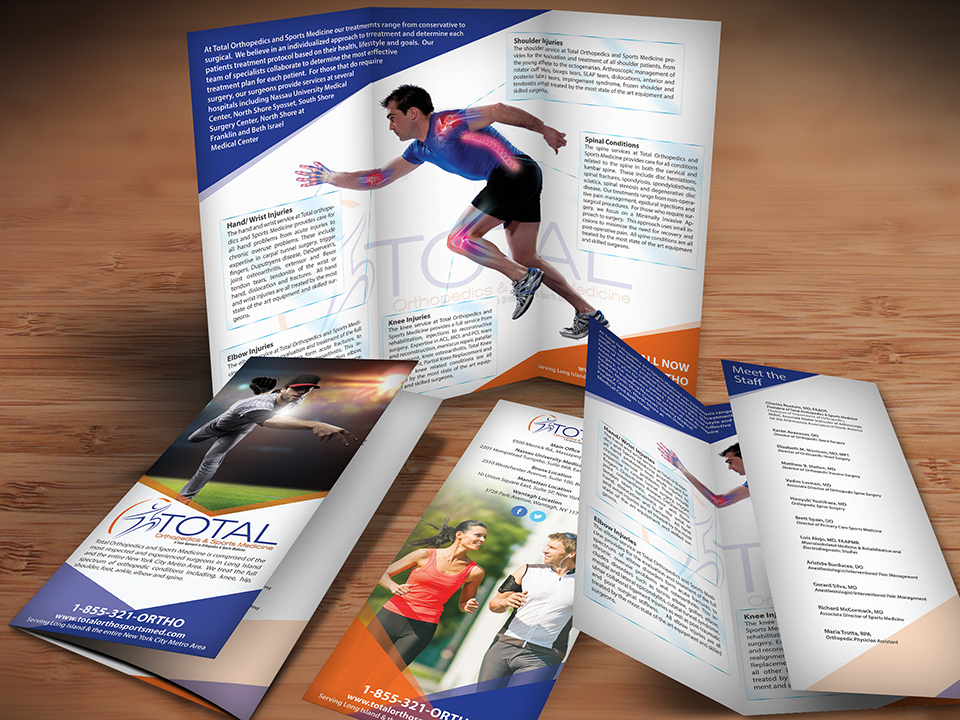
Orthopedic and Sports Medicine Brochure Design
Brochure design for Total Orthopedics, a medical office in Long Island, New York, that specializes in orthopedics and sports medicine.
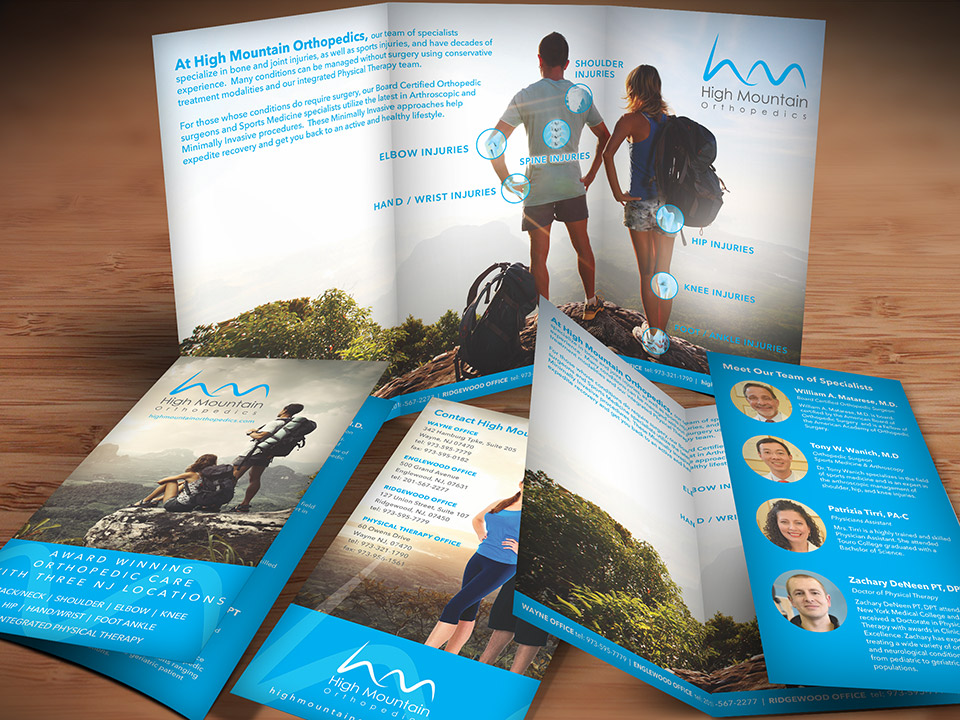
Orthopedic Pain Brochure
Specialty practice brochure covering total joint replacements, arthroscopy, and non-surgical physical rehab options.
How Medical Brochure Projects Are Quoted & Scoped
Every medical practice has distinct patient volumes, procedural complexities, and clinical goals. We provide transparent, custom quotes based on six straightforward project factors, with no hidden fees.
Copywriting & Clinical Content
Whether your doctors supply finalized copy, rough procedure notes, or need our healthcare creative team to draft patient-friendly educational text from scratch.
Format & Folded Dimensions
Standard 6-panel tri-fold (8.5x11 flat, folding to 3.66x8.5), 8-panel double gate/parallel fold, or multi-page saddle-stitched booklets (8 to 16 pages) for surgical centers.
Anatomical Diagrams & Custom Art
Medical-grade 3D anatomical illustrations, mechanism of action graphics, custom procedure flowcharts, or curated photography from our verified medical image registry.
Paper Stock & Tactile Finish
100lb gloss/matte text, sturdy 100lb cover cardstock, soft-touch velvet lamination, spot UV gloss over anatomical graphics, or aqueous protective coatings.
Print Quantity & Volume Tiers
Small runs (250 or 500 copies) for boutique practices or pilot tests, up to high-volume production (1,000, 2,500, or 5,000+ copies) for maximum cost efficiency per unit.
Proofing, Turnaround & Delivery
Digital PDF and press-accurate proofs, standard 5–7 business day production, rush delivery options, and nationwide ground or expedited shipping directly to your office.
Requesting a 250 vs. 1,000 Copy Comparison
Because press setup is a fixed cost, printing 1,000 copies typically costs only marginally more than 250 copies, significantly lowering your cost-per-brochure. When submitting your quote request, simply note that you would like a two-tier comparison and we will provide exact numbers for both quantities.
Frequently Asked Questions
Common questions about physical therapy brochure design.
Ready to Design Your Brochure?
Talk with our healthcare creative team about your physical therapy brochure project. Call 888-803-2021 or request a free consultation online.
Explore all brochure design services