
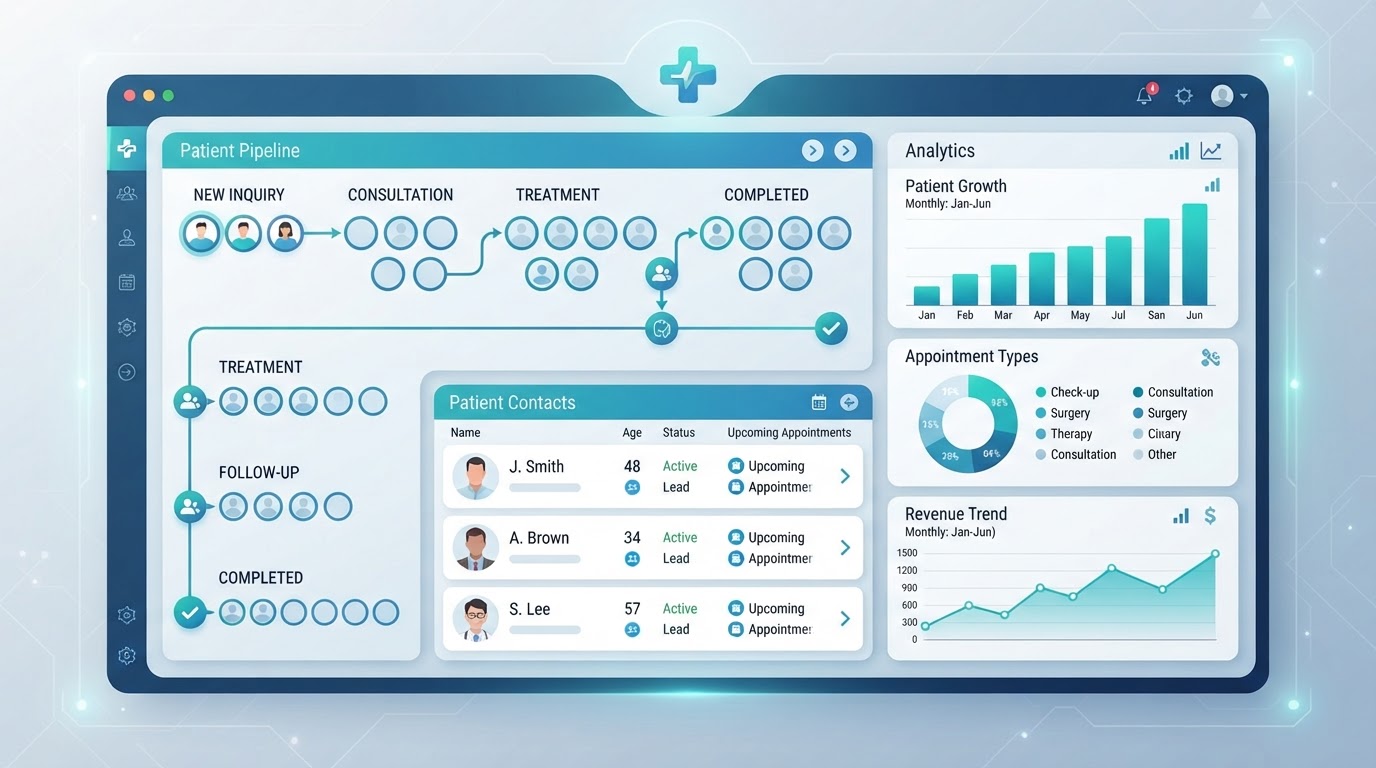
CRM for Medical Practices: Manage Patient Relationships
A Customer Relationship Management (CRM) system helps medical practices manage patient relationships, marketing campaigns, and communications in one organized system. While your EHR manages clinical records, a CRM manages the marketing and relationship side—tracking inquiries, nurturing leads, automating communications, and measuring marketing ROI. For practices serious about growth, a CRM is the system that ties marketing efforts to patient acquisition and retention. Our medical marketing services include CRM strategy and implementation.
A CRM centralizes patient and prospect information, automates marketing workflows, and provides insights into what's working. Instead of patient inquiries scattered across phone messages, emails, and forms, a CRM organizes them into a manageable system with automated follow-up. Practices that use a CRM consistently capture more inquiries, convert more patients, and retain them longer. The American Medical Association (ama-assn.org) recognizes patient relationship management as a component of practice quality.
Key benefits and uses of a CRM for medical practices include:
1. Centralized Patient and Prospect Data: A CRM centralizes all patient and prospect information—contact details, inquiry source, communication history, appointment status, and marketing engagement. No more scattered sticky notes and lost messages. Everyone on your team sees the same complete picture. Centralized data improves service and follow-up.
2. Lead Capture and Nurturing: A CRM captures inquiries from your website forms, chatbot, phone calls, and ads, then nurtures them with automated follow-up. A patient who inquires but doesn't book immediately receives automated emails encouraging them to schedule. Lead nurturing captures patients who would otherwise be lost. Our consultation form integrates with CRM lead capture.
3. Automated Communication: A CRM automates patient communication—appointment reminders, recall messages, welcome sequences, and educational content. Automated, personalized communication improves engagement and retention while reducing staff workload. See our email marketing and practice automation guides. The CAN-SPAM Act (ftc.gov) governs email communication.
4. Marketing Campaign Management: A CRM manages marketing campaigns—email sequences, segmentation, and scheduling. Segment your patient list by type, procedure interest, or demographics, and send targeted campaigns. Segmented campaigns outperform generic blasts. A CRM makes sophisticated campaign management practical. See our email marketing guide.
5. Multi-Channel Tracking: A CRM tracks patient interactions across channels—website visits, form submissions, phone calls, emails, and appointments. This reveals the complete patient journey and which channels drive the most valuable patients. Multi-channel tracking enables data-driven marketing decisions. Google Analytics 4 (analytics.google.com) complements CRM tracking.
6. Appointment and Pipeline Management: A CRM manages the patient pipeline from inquiry to appointment to treatment. Track where each patient is in the process, follow up at the right time, and identify bottlenecks. Pipeline management ensures no patient falls through the cracks. This is especially valuable for high-value procedures with longer decision cycles.
7. Patient Segmentation: A CRM segments your patient base by type, procedure interest, demographics, and engagement. Send implant information to patients who inquired about tooth replacement, not your entire list. Send sports physical reminders to families with school-age children. Segmentation improves relevance and response. See our email marketing guide.
8. Reputation Management: A CRM can automate review requests after positive visits and track your online reputation. Send review requests via email or SMS within 24-48 hours while the experience is fresh. Automated review requests build your reputation consistently. See our reputation management services.
9. Analytics and ROI Measurement: A CRM provides analytics on marketing performance—lead sources, conversion rates, campaign ROI, and patient lifetime value. This reveals which marketing efforts drive the most valuable patients. Data-driven marketing outperforms guesswork. Practices that measure ROI optimize their marketing spend effectively.
10. HIPAA-Compliant Implementation: A CRM handling patient data must be HIPAA-compliant with encrypted transmission, secure storage, and a signed Business Associate Agreement. Not all CRMs are suitable for healthcare. Ensure your CRM vendor signs a BAA before sharing any patient information. The HHS (hhs.gov/hipaa) provides BAA requirements. Our services ensure compliant CRM implementation.
11. Integration with Practice Systems: A CRM should integrate with your EHR, practice management system, and marketing tools. Appointment data flows between systems. Patient information syncs automatically. Integration eliminates double data entry and keeps systems in sync. The Centers for Medicare and Medicaid Services (cms.gov) provide data interchange standards.
12. Patient Retention: A CRM improves retention through automated recall, follow-up, and personalized communication. Patients who receive consistent, relevant communication stay engaged and return for ongoing care. Retention is far less expensive than acquisition—a CRM makes retention systematic. See our patient retention guide.
A CRM is the system that ties your marketing efforts to patient acquisition and retention. Practices that use a CRM consistently capture more inquiries, convert more patients, and retain them longer. Explore our medical marketing services, browse our portfolio, or request a free consultation to implement a CRM for your practice.
Frequently Asked Questions
Explore our services
Learn how we help medical practices grow with Medical Marketing for Practices.